



Custom CRM
development
Custom CRM development makes sense when ready-made tools push your team into workarounds: side spreadsheets, paid add-ons for basic features, seats for people who only need one screen. I build a CRM around how your business actually sells and delivers, for a fixed $6,000, and the code is yours.
Free: a 30-minute call, an action plan and a price range in writing.
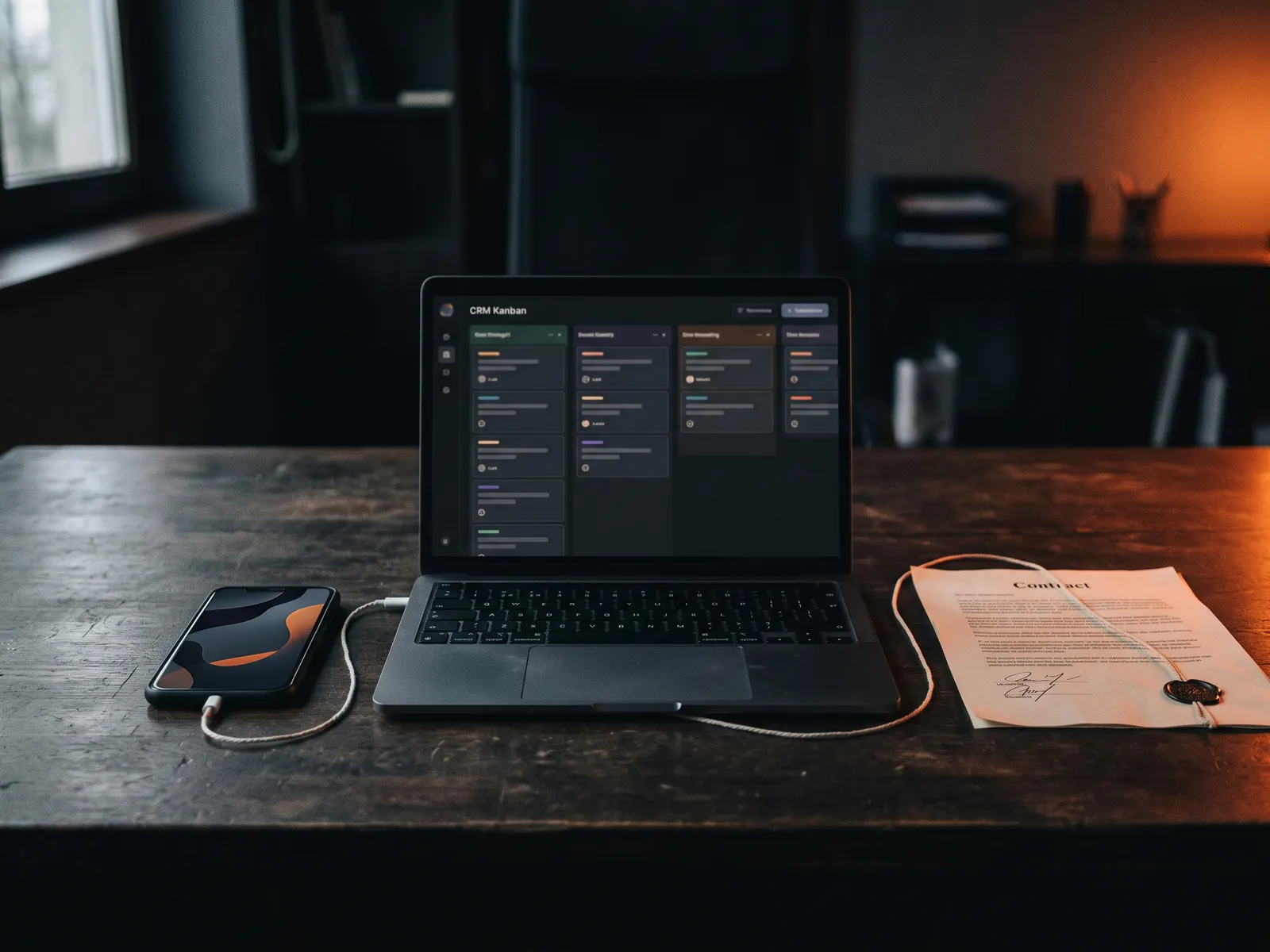
What a custom CRM does
that rented tools struggle with
Off-the-shelf CRMs are designed for a typical sales team. These are the jobs where they start to pinch.
Your own stages and fields
Site visit, measurement, design approval, deposit, install. Your words, your order, no fields you never use.
Quotes and documents
Estimates, work orders and contracts generated from the deal card in your format, ready to send.
Scheduling
Crews, rooms or staff calendars inside the CRM, so booking and the sales pipeline are the same system.
Simple screens for the field
A phone view for technicians or drivers that shows today's jobs and nothing else.
Integrations without plugins
Website forms, lead ads, chatbots and payment notices connected directly, without a monthly connector bill.
Reports you actually read
The five numbers you check every Monday on one screen, not a dashboard builder you never open.
The inquiry handles
itself, you just call
The form, the message to the client and the CRM task connect into one flow, with no retyping by hand.
- Automatic reply
- Task with a deadline
- Stage visible in the CRM
How a custom CRM
gets built
The timeline is fixed in the agreement after the brief, and late-delivery penalties can be written into the contract.
Custom CRM
pricing
Final prices in US dollars. Payment in three stages (30/40/30), tied to milestones in the agreement.
Built for your process and owned by you.
- Pipeline, fields and user roles
- Data import
- Website and lead ad integrations
- Training and launch support
- Hosting agreed individually
If HubSpot, Pipedrive or Zoho fits well enough, this is faster and cheaper to start.
- Quicker launch
- License paid to the vendor
Projects where the CRM
follows the business
Large website, booking system, CRM and ads for a clinic. The project has just launched; I'll share results once there are hard numbers.
See the case study →Website with online ordering, CRM and ads. Over PLN 15,000 a month (about $4,000) in delivery orders through the site.
See the case study →When custom CRM development is the right call
Custom CRM development is not for everyone, and I turn down projects where a $3,000 ready-made CRM setup would do. It is the better choice in a few clear situations:
- Your process does not fit a standard pipeline. For example, a remodeler with site visits, design rounds, permits, deposits and installation crews.
- Many users need only a little. Ten technicians who just need today's jobs on a phone should not each cost a monthly seat.
- You need your own documents. Quotes, work orders or contracts generated from the CRM in your exact format.
- You keep paying for add-ons. Scheduling, document generation and form connectors from three vendors on top of the CRM itself.
If none of these apply, read my comparison of custom CRM vs HubSpot and Pipedrive before deciding.
What I build and how
The CRM is a web application your team opens in a browser on a computer or phone. It is built on the same foundation I use for websites on a custom CMS: fast, secure and designed for one business rather than for everyone. Typical parts are a pipeline board, contact and company cards, tasks and reminders, documents, a calendar, user roles and a simple reporting screen.
Before writing code I make a clickable prototype. You and your team click through it, say what is missing or confusing, and I adjust it. Changes at that stage take minutes. Only after you approve the prototype does real development start.
Working with someone in Europe on a build like this is simpler than it sounds. Your morning overlaps with my afternoon, so a question sent at 9 a.m. Eastern usually gets an answer the same day. You see progress on a test version rather than in status emails, and you always talk to the person writing the code, not an account manager relaying messages.
Integrations without plugins
Because I control the code, integrations are built directly instead of through monthly connector services. Typical connections: your website's contact and quote forms, Google and Meta lead forms, a chatbot, email notifications, payment confirmations and your calendar. Each lead keeps its source, so end-to-end analytics can show which campaign brought which signed job, not just which one brought clicks.
Price, timeline and ownership
The price is fixed at $6,000, paid 30/40/30 against milestones written into the agreement. Hosting is agreed individually and billed to you. The timeline is set after the brief and also written into the contract, with late-delivery penalties if you want them. Three rounds of revisions, training and launch support are included.
The code and data belong to you from day one. If you ever want another developer to take over, you hand them the repository. There is no license, no lock-in and no monthly fee to me unless you choose ongoing support, which you can cancel with one month's notice.
Privacy by design
A CRM holds your customers' names, phone numbers and often addresses, so I design it to collect only what the business needs. Access is split by role, logins use two-factor authentication and every change to a record is logged. If a customer asks you to delete their data, there is a single button for that. Businesses in healthcare should discuss HIPAA with their compliance advisor before storing patient information in any CRM, custom or not. If a state privacy law applies to you, the export and deletion tools make requests quick to handle.
Next step
Fill in the CRM brief or send a short description of your process. I reply within one business day, often with questions, and then suggest a free 30-minute call. You get a written proposal with scope, price and deadline. If my honest answer is that a ready-made tool fits better, you will hear that too.
Read before
you decide
Custom CRM
questions
Why pay $6,000 when HubSpot has a free plan?
The free plan is a good start, but the features small businesses end up needing, such as automation, custom objects or more users, sit in paid tiers billed per seat every month. Over a few years, a team of six or eight can pay more in licenses than a one-time build. If a ready-made CRM fits you, I will recommend that instead.
Who owns the code and the data?
You do. The code is registered to you and handed over with access to the repository, and the data sits on hosting in your name. You can hire another developer later without asking my permission. The same rule applies to everything I build: domains, ad accounts and website code stay in the client's name.
Where is a custom CRM hosted?
Hosting is agreed individually, usually a reputable cloud provider with a US data center, regular backups and an encrypted connection. The cost depends on users and data volume and is billed to you directly. I set it up and explain what you are paying for before you sign anything.
What if my process changes later?
That is one of the advantages of owning the system. A new stage, field or report is a small paid change, not a migration to a different tool. Some clients keep me on a monthly arrangement for such changes, with no minimum term, while others order them one at a time when needed.
How long does a custom CRM take?
It depends on scope, which is why the deadline is set after the brief and written into the agreement. A focused CRM for a small team takes longer than the roughly 15 days of a ready-made setup, since it includes a prototype and a test week with your staff. I give you a specific date before you pay the deposit.
Describe your process,
I'll tell you honestly
Send a short description of how a customer moves from first contact to payment. If a ready-made CRM would do the job, I'll say so and save you money.
- 9 short steps
- No obligation
- I reply personally
- I reply within 1 business dayPersonally, by email or on WhatsApp, whichever you prefer.
- A 30-minute call, freeI ask about your business, customers and budget. Beforehand I review your website and ads.
- A proposal with a price, in writingWhat I’ll do, by when and for how much. You decide with no pressure.
Where do your inquiries go today?